
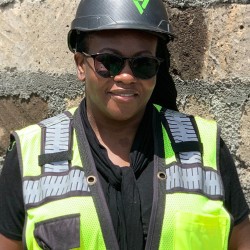
Sylvia Githaiga
I was born and raised in a place called Dagoretti Corner. A humble place, our estate had 10 bungalow units with no fences or gates separating one house from another. People were free to walk into each other’s homes to borrow sugar or share a meal together without notice or ‘an appointment.’ We were happy there for most of my childhood, until one day, a gang of robbers found their way into our estate. Luckily, my family was spared, but the screams from my neighbors, people I knew and cared for, sent chills down my spine, and I can still recall that incident very vividly.
That was the beginning of the part of my life I call, ‘A Series of Moving Houses.’ After the robbery, we hopped from one place to another until finally settling in Kikuyu. In our block of 15 units, there was one particular neighbor who caught my attention. He was a quiet man who carried around large rolls of weird paper and small model houses, and the more I watched him, the more my curiosity about his life grew.
One day after church, he and his wife offered me a ride home, and I discovered he was an architect. Sensing my interest, he invited me into his home where I was greeted by an array of drawings, models, and scrap materials. He showed me how he could bring those incredible sketches to life with only his hands and mind, and that made me realize no human is limited: if you can dream it, you can build it into something real and tangible. It was as if a whole new world opened up to me in that living room and suddenly it was clear: this was my calling.
I had taken a break from school to think about college and my next step, and I spent that year immersing myself in my neighbor’s work. I helped him cut pieces of boards to make small houses, studied his drawings endlessly, and learned everything I could from him. He welcomed me into his life, shared his knowledge and experiences, and became my mentor, urging me to follow my passion and grow my talent.
At that point, my parents already had my career planned out for me. My mother wanted me to be an accountant, and my father was convinced he could mould me into an engineer. With my brother studying abroad in America, he treated my sister and I like his sons. He taught us all about car engines, showed us how to change a tire and light bulb, and he always said, ‘women can do anything men can do, sometimes even better.’
While I didn’t become an engineer, his words have helped me through some of my toughest challenges in the industry. Although I graduated with honors from both Kenya Polytechnic and Jomo Kenyatta University of Agriculture and Technology, I entered architecture facing a very unequal playing field. Women in the industry make less than our male counterparts at every stage, see fewer opportunities come our way, and it is tougher for us to be a voice in the industry – a voice people listen to anyway!
Discrimination and old stereotypes set out by our forefathers lie behind each hurdle, and I fight every day to prove that women have an important place in the industry, and to pave the path for those who will come after me. We are rising stars in what has been an all-male galaxy and not only are we smart and strong enough to survive, we can truly soar in this career, despite the negativity that surrounds us.
It is these challenges and preconceived notions that make me so determined to change the face of architecture in Kenya, and Nairobi Street Kitchen was the perfect opportunity for this. NSK is a bold new dining experience and everything we designed, from creating entire restaurant spaces out of repurposed buses and containers, to using a distressed roadside bathtub for a bathroom sink (!) merge the old and meaningful with new, fresh concepts, and Nairobians can now experience the endless possibilities and beauty that come with creative, thoughtful design.
This is a space that brings us together once more, after being hit so hard by the pandemic, and which celebrates, in every manner, our vibrant city and community. Working on it was truly a roller coaster ride of emotions – joy, pain, frustration, and fulfillment – and at the end of it all, I couldn’t be prouder, or more grateful, to have been a part of it.